
Consolidated on Bryan’s instruction (2026-06-02): folds the v2 "DIY-generous" Setting-it-up section into the full v1 body, and resolves the one remaining publish blocker by reframing the cohort line to a plain observation with no placeholder number. This is the single publish-ready body; supersedes v1 and the v2 partial. Featured image = candidate 3 (Bryan’s pick).
[Vicki] meta: category: Direct Bookings
[Vicki] meta: tags: Google Ads, OTA commission, direct bookings, brand protection, SEM
[Vicki] meta: description: Booking.com bids on your property’s own name and intercepts guests who already chose you. Here is the brand-protection campaign that stops it, and the budget that pays for itself in week one.
[Vicki] meta: slug: bid-on-your-own-brand
—————————————-
Bid on your own brand or watch Booking.com keep doing it for you.
Someone typed your property name into Google last Tuesday. They were not browsing. They already knew you. Their intent was locked. And Booking.com captured them anyway.
This is not a fringe case. It happens on thousands of AU accommodation properties every day. Booking.com spends multiple billions of dollars annually on performance marketing, a significant portion of which funds search ads triggered by accommodation brand names. And most operators never find out until they look.
The ad sitting above your own website
Here is the mechanism. A guest decides they want to stay at your property. They open Google and type your property name. Above your website, sometimes above your Google Business Profile listing, a paid ad appears. The headline includes your property name. The link goes to Booking.com’s page for your property. The guest clicks. They book. You pay commission on a guest who already decided they wanted you.
That is not a competitive market outcome. That is a commission charged on intent that was already yours.
The pattern is called brand SERP hijack. The guest arrived at the top of your funnel having already done the research. By the time they searched your name, you had won. The interception happened after the win.
Your website still gets the organic click in many cases. But the paid result sits above it. First result wins. First result belongs to whoever paid for it.
Why your brand campaign does not exist yet
Most operators we audit have no brand protection campaign running at all.
That is not a failing. It is information asymmetry.
Nobody tells you this is possible when you sign up for Booking.com or Expedia. Google’s ad interface does not prompt you to protect your own name. Your property management system handles your rates and reservations, not your search visibility. And if you have worked with a digital marketing agency, the chances are they were focused on generic reach terms like "Coffs Harbour accommodation" or "Burleigh apartments," because those drive new-audience impressions. New-audience impressions make a better-looking report.
Brand protection is quieter work. It defends a guest you had already won. It does not generate the kind of impressions chart that fills a monthly agency deck.
Nobody told you to set it up because it does not serve anyone else’s reporting interest to tell you. Only yours.
The maths that justifies the budget in week one
Take an illustrative property with an average booking value of $650 and a Booking.com commission rate of 16%.
Every booking Booking.com captures on a brand-intent search costs $104 in commission. That is $104 on a guest who typed your name into Google.
A Google Ads brand campaign for the same property bids on the property name as a keyword. Because the advertiser is the actual brand, their Quality Score for that keyword is high. Quality Score is Google’s internal rating of relevance: ad, keyword, and landing page. When all three align on your own brand name, the score is high. High Quality Score means your cost per click is lower than a third party bidding on the same term. Brand keyword CPCs in AU typically run between $0.30 and $1.50, depending on how much search volume the property name carries.
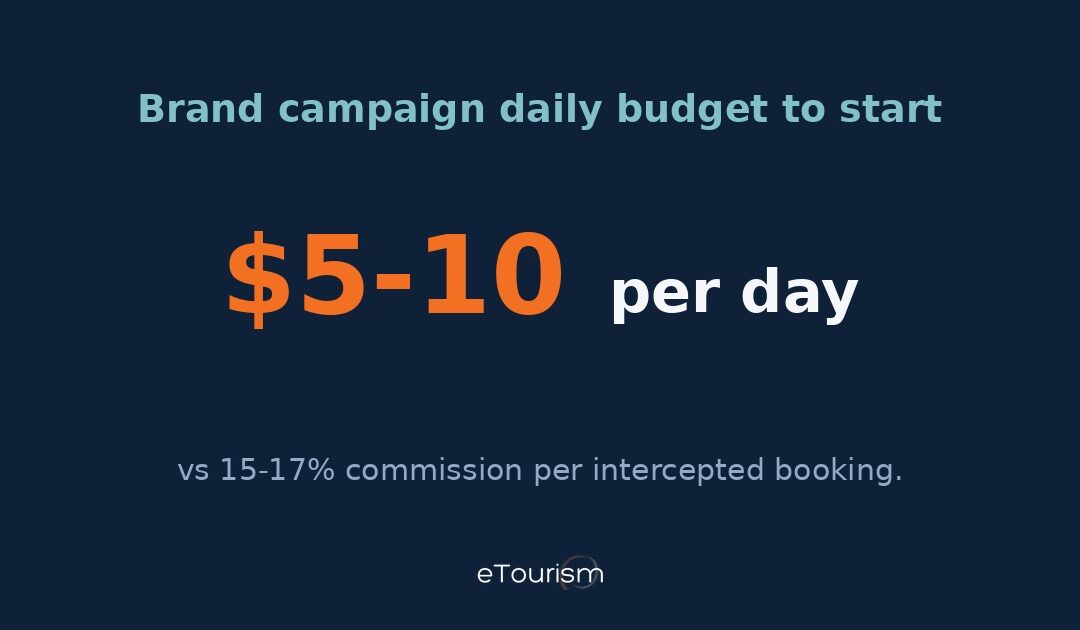
Budget this campaign at $10 per day. That is $300 for a full month.
If Booking.com is capturing even three brand-intent bookings per month on this property, recovering those three bookings via a direct campaign saves $312 in commission against $300 in ad spend. The maths close before the first statement arrives.
The numbers above are illustrative. The mechanism is not.
Setting it up takes thirty minutes. Keeping it sharp is the ongoing bit.
You can absolutely set this up yourself. You need a Google Ads account, your booking engine URL, and the steps below. It is also one of the first things we run inside Boost Direct for the properties we work with, so if you would rather hand it off, that door is open. Either way, here is the whole thing.
Step one: create a new Search campaign. Name it clearly. "[Property Name] Brand Protection" is fine. Set the campaign goal to website traffic.
Step two: add your keywords. Two is enough. Exact match: [your property name]. Phrase match: "your property name". You are not trying to reach new audiences. You are protecting searches that are already heading to you.
Step three: write one simple ad. Headline one is your property name. Headline two is "Book direct, official site." Headline three is a short descriptor for your property ("Absolute beachfront, Currumbin, 2 to 4 bedroom apartments" works). Set the destination URL to your booking engine, not your homepage. The booking engine is where the decision completes. Do not add a step between the click and the booking form.
Set your daily budget at $5 to $10 to start. Run for two weeks. Check the search terms report to see which queries triggered your ads. If your brand name and its common variations are appearing there, you are blocking the interception.
One thing to note: if a competitor or OTA outbids you occasionally, Google will still show your ad because your relevance score for your own name is structurally higher than theirs. You do not need to win every auction. You need to be present in enough of them to make the interception unreliable.
Setup is the easy half. The ongoing half is the work most operators end up handing off. Checking the search terms report every week or two. Adding negative keywords so you are not paying for clicks you do not want. Watching for a new OTA or competitor starting to bid against you. Expanding the keywords to cover the common misspellings of your property name. None of it is hard on its own. It is one more recurring job on a list that is already long, and a campaign left unattended for six months quietly stops doing its job. That is the point where a lot of operators decide it is worth having someone run it for them.
Do this now, before you read another word
Open a private browsing window. Type your property name into Google.
If you see a Booking.com ad, or an Expedia ad, or a Stayz ad in the top position above your website, you have a live brand hijack running today. Every booking they capture from that spot costs you 15 to 17% commission on intent that was already yours.
A brand protection campaign does not fix every commission leak. But it fixes the most avoidable one: paying OTA rates on a guest who had already chosen you.
Want us to run a brand SERP check as part of a full digital audit? Reply to this post.