
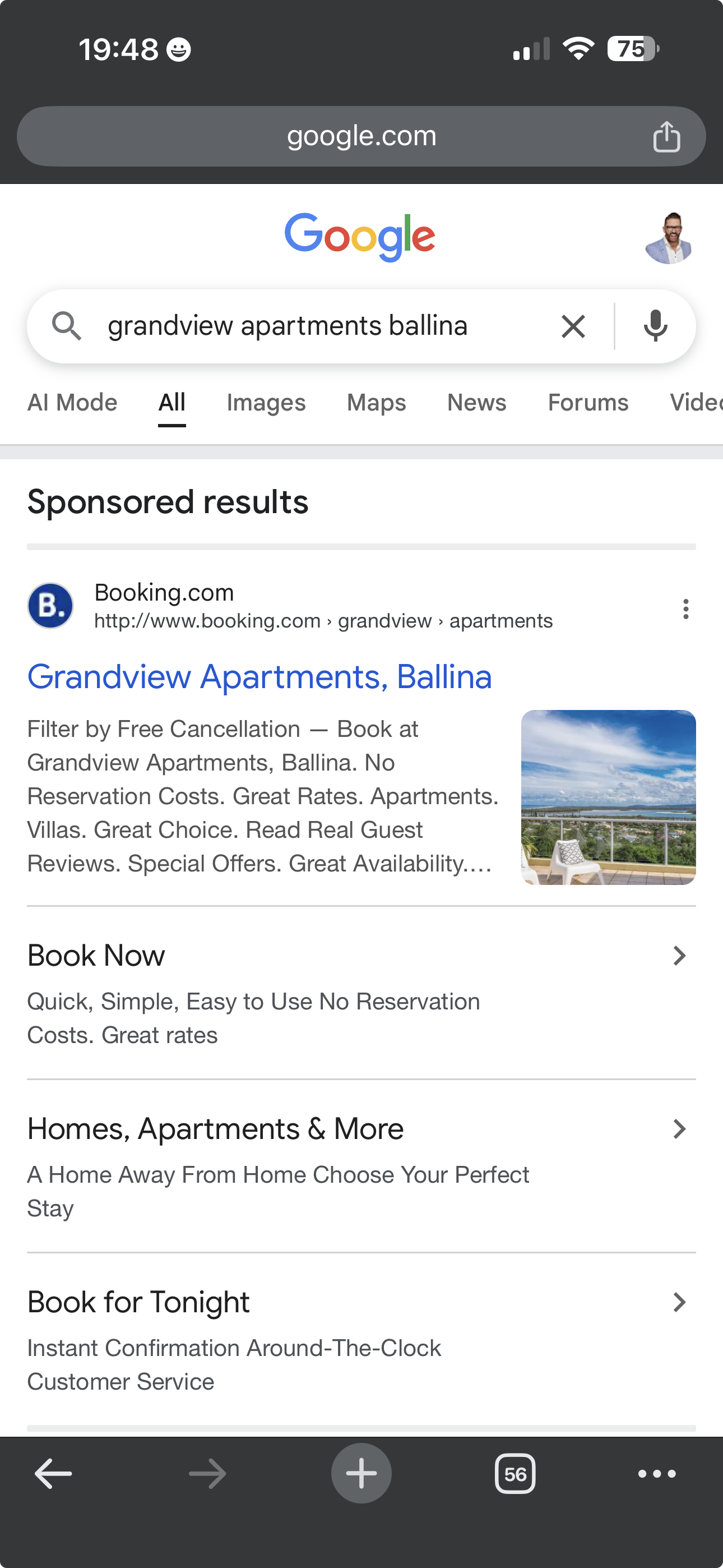
Type your own property name into Google. Did you scroll past Booking.com to find your website?
Most operators have done this once. Most quietly closed the tab.
Here is the part nobody says out loud. The guest who searched your name was already yours. They had already heard of you. They wanted to be at your property. Then they clicked a Booking.com listing and you paid 18% to host the booking on your own room.
This is not Booking.com winning. This is your defensive SEO failing.
What is actually happening
When someone Googles your property name and town, they have done the hard work for you. The marketing is over. They picked you. All your website has to do is be the first thing on the page.
Most accommodation websites are not. When we run a brand-name Google search for an AU coastal property, more often than not the official site sits outside the top three results. The slots above it are OTA listings. You can try this yourself in 30 seconds.
OTA listings outrank you because OTAs run an organised, well-funded brand-defence program against your brand. They write schema markup. They bid on paid search for your name. They keep their listing page fresh and crawlable. Your homepage was built in 2019 and the title tag still says “Home – Driftwood Apartments”. (Driftwood Apartments is fictional. Your version of it almost certainly is not.)
The OTA is doing the SEO work you stopped doing. Then taking 18% for showing up.
The number that should make you angry
Take an illustrative property doing 80 direct-style bookings a month at an average rate of $400 a night for 3 nights. That is $96,000 a month in revenue that was on its way to your booking engine.
If even a third of those guests Googled your name, hit a Booking.com result first, and booked on the OTA at an 18% effective commission, that is $5,760 a month going out the door. Roughly $70,000 a year. On guests you never had to find, who already wanted to stay with you, who would have come to your direct site if it had been the first thing they saw.
You did not lose those guests to the OTA. You handed them over.
The three-step fix
This is operator-doable. Every step is something you can have done inside two weeks.
1. Add brand schema to your homepage. Schema.org defines a Hotel type (https://schema.org/Hotel) that tells Google “this is the official site for this property”. Most accommodation sites have generic LocalBusiness schema or none at all. Adding a proper Hotel schema block, with your name, address, phone, official email, and your own logo URL, is a one-time job. A developer can do it in an afternoon. From our experience deploying it across client sites, Google typically rewards the change within four to eight weeks by giving the official site the Knowledge Panel slot and quietly demoting the OTA listings underneath it.
2. Buy your own brand name on Google Ads. Cheaply. Operators hate hearing this because it feels like paying for traffic you already own. Run the maths. From the Google Ads accounts we manage in 2026, brand-name long-tail clicks (property name plus town) typically clear between $0.20 and $0.50, because nobody else competes on a phrase that specific. A 3-night booking at our illustrative property is $1,200. Your commission saving on that single booking is more than $200. You can buy 400 brand-name clicks for the price of one OTA-paid commission. This is not a marketing expense. It is an insurance policy on guests you have already won.
3. Clean up your homepage so Google can read it. Title tag should say your property name, your town, and “Official Site”. Your H1 should match. The first 100 words of homepage copy should mention the property name twice and the town once. Nobody is going to read this section of your homepage. Google is. The OTA’s listing page is doing all of this. Yours probably is not.
“Won’t Booking.com just outbid me?”
They will not. Booking.com does run brand-defence ads in some markets, but from running counter-campaigns across our client base, we rarely see a Booking.com bid above $0.50 on a long-tail brand query for a single small property. The economics do not work for them at scale. They are happy with the organic listing. The paid slot, if you take it, is yours for almost nothing.
The one thing that does work for them is operators who do not turn up. So turn up.
What to do this week
Open Google. Search your property name plus your town. Take a screenshot.
Count how many results sit above your official website. If the answer is zero, congratulations. If the answer is one or more, this is the cheapest direct-booking lift available to you, and it has been there the whole time.
The OTA did not steal those guests. The OTA showed up. You did not.
Show up.
Sources and methodology
OTA commission (18%) [O]: Booking.com’s effective take rate on AU small-property inventory typically runs 15-22% once Genius and Preferred Partner discounts apply. 18% is a generous round-number observation from accounts we see. Booking.com does not publish commission rates publicly; check your last statement for your real figure.
Brand-name SERP outranking observation [O]: From the brand-name Google searches we run on AU coastal accommodation as part of prospect audits in 2026, the official site sits outside the top three results more often than not on a “property name + town” query. The reader is invited to verify this directly on their own brand name, which is the point of the post.
Hotel Schema (https://schema.org/Hotel) [E]: Schema.org’s canonical Hotel type. Implementing it as JSON-LD on the homepage is the structural signal Google uses to identify the official site for a property.
Knowledge Panel reward in four to eight weeks [O]: Observational from eTourism deployments. Not a Google-published SLA.
Brand-name Google Ads CPC ($0.20 to $0.50) [O]: Observational from eTourism-managed Google Ads accounts in 2026.
Booking.com counter-bid behaviour [O]: Observational from running brand-defence campaigns across the eTourism client base. Long-tail brand queries for a single small property rarely attract Booking.com bids above $0.50.
Illustrative property example [X]: “Driftwood Apartments Coffs Harbour” is fictional. The example of 80 bookings at $400 a night for 3 nights is arithmetic for illustration, not a statistical claim about any cohort.