
Most operators we speak with have been posting to Instagram three times a week for four years. The photos are genuine. The captions are thought out. The follower count climbs slowly.
The bookings line sits flat.
The problem is not your content. The platforms changed the deal, and nobody called to let you know.
A number that should irritate you
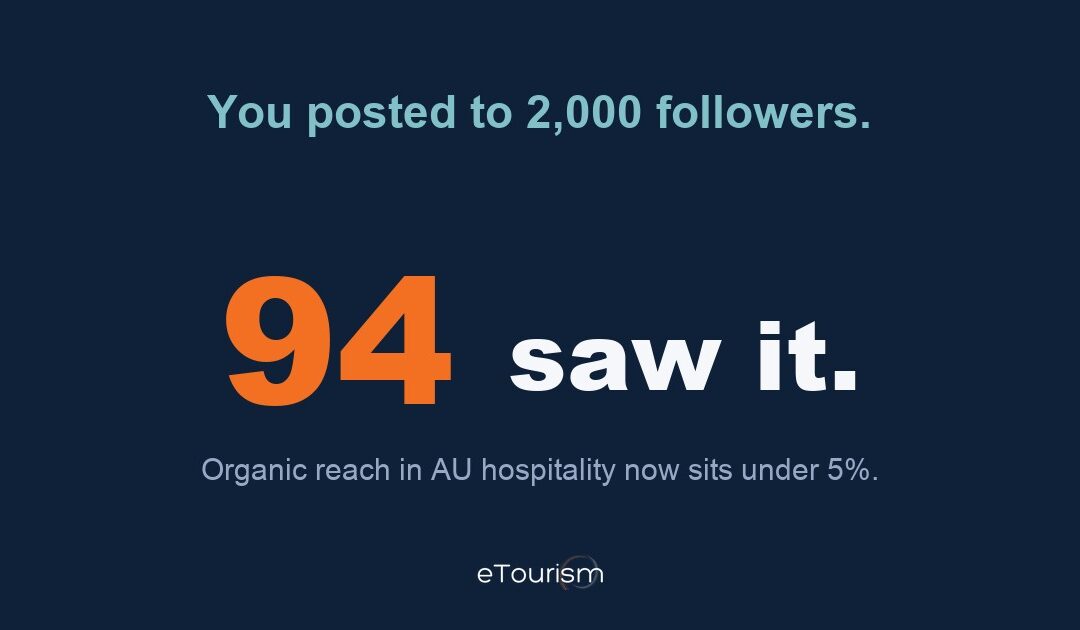
Industry research puts Facebook organic reach in the low single digits, under 5% of followers, and Instagram is on the same track. Post to 2,000 followers tonight and fewer than 100 people see it. The other 1,900 see a Reel from someone they follow personally, a boosted post from a resort with a paid budget, or a sponsored carousel from an OTA spending four grand a month.
Hootsuite’s annual social trends research tracks the same decline across every vertical, and the accommodation properties we run programmes for are no exception. This is not a one-property problem. It is a platform problem.
The 5% figure is the baseline. It is not the floor.
Followers are not distribution
Here is the mental model that trips operators up. A follower count feels like an audience. It feels like distribution. It is a database entry with a mute button installed.
In the early 2010s, following a page meant you saw that page’s posts. That mechanic held for a few years. Then Facebook announced in January 2018 that the News Feed would prioritise posts from friends and family over pages and publishers. The stated reason was meaningful social interaction. The business reason was simpler: if your organic content reaches nobody, you buy ads.
Instagram followed the same path. TikTok is replicating it faster than either of them.
Followers still matter. Just not as distribution. They are social proof (a property with 3,000 followers looks credible to a cold visitor clicking through from an ad), a signal to the algorithm about who is in-market for your type of property, and a retargeting pool you can reach via paid campaigns at a lower cost than cold audiences.
Those three things are useful. Distribution is not one of them.
The platform is an advertising business. Run it that way.
Meta’s product is not your content. Meta’s product is reach. They will sell you reach to the exact people you want, at a cost you can measure, with a return you can track. Your organic post is a free sample they show to a fraction of your list. They charge you for the rest.
Understanding that mechanic is the difference between a paid budget that compounds and one that disappears into a content calendar nobody reads.
The decline in organic reach is not a bug in the platform. It is the feature. Every percentage point of organic reach they suppress is a percentage point they can resell.
Boost Direct, eTourism’s direct booking programme, is built on this mechanic. Paid campaigns on Meta channel direct-booking intent to your own booking engine, not to an OTA’s. You are buying reach on a platform that actually sells reach, and routing that traffic somewhere you keep the margin.
What to do differently this week
Stop measuring follower growth as a marketing metric. Start measuring cost-per-direct-booking from paid social.
Keep posting organically. Your profile needs depth. A visitor who clicks through from a paid ad will scroll back two or three posts, and what they find affects whether they book. But the organic post is not doing the distribution work. The ad is.
Run even a modest paid campaign. Twenty dollars a day in a well-structured Meta campaign will reach more targeted potential guests than three months of organic posting to your existing follower list.
Stop optimising for the metric they took away
The platforms trained a generation of operators to care about reach, engagement rate, and follower growth. Then they dialled organic reach down to a fraction of what it was, and started selling the rest back at auction.
The operators winning direct bookings right now are not the ones with the most followers. They are the ones who stopped pretending organic reach was still the game.
Pay for reach to the right people, or keep talking to an empty room.