
Every operator has an internal clock for how fast marketing should work.
Meta ads are expected to work in 30 days. They usually do. You boost a post, the bookings move, you can see it in the dashboard by Friday. Google Ads are expected to work in 60 days. They usually do too. The campaign warms up, the brand and high-intent terms start converting, and within two months the spend is paying for itself.
Then there is SEO, which everyone expects to work in 90 days. It almost never does. And that is where most operators make the mistake that costs them the channel.
90 days is not where SEO compounds
At 90 days, an SEO programme has done a lot of work you cannot see. New pages are indexed. The site structure is fixed. Schema is in. The content that answers real traveller questions is written and published. None of it has moved the booking line yet, because rankings take time to build, and the traffic that follows rankings takes more time again.
So at the 90-day review, the organic line looks flat. The operator who was promised "SEO" looks at a flat line and concludes it does not work. They cut it, move the budget to ads, and never find out what was about to happen.
Because 90 days is not where SEO compounds. Eighteen to twenty-four months is.
Why the curve is flat and then steep
Paid traffic is linear. You put a dollar in, you get a click out, and the moment you stop paying, the clicks stop. SEO does the opposite. It does almost nothing for months, and then it does a great deal, because every piece of it accrues.
A page that ranks on page two for a year quietly climbs to page one. The content you published in month three starts getting cited in month twelve. The links and mentions and entity signals build on each other. Google gets more confident about what your site is and who it serves, and that confidence shows up as rankings across a widening set of queries, not just the ones you targeted. The work does not add up. It multiplies. That is what compounding means, and it is why the curve is flat early and steep late.
The operators who win the channel are the ones who hold their nerve through the flat part.
What 24 months actually looks like
Here is one property we manage, with the numbers kept as they happened.
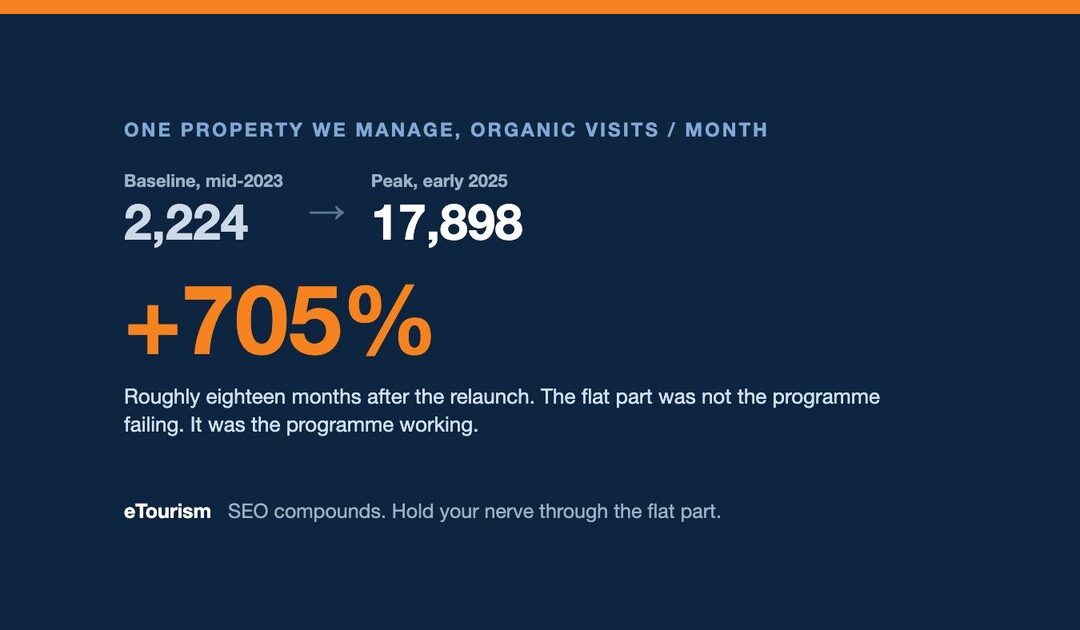
Before the programme started, the site was averaging around 2,224 organic visits a month through the middle of 2023. Respectable, stable, and going nowhere in particular. We relaunched the website in October 2023, then kept the content and technical work running every month after that.
For the first stretch, the line did what SEO always does. It moved slowly. Through 2024 it climbed, steadily and without drama, the kind of growth that does not make a quarterly review feel exciting. Then the compounding caught up. By early 2025 the site peaked at 17,898 organic visits in a single month.
That is 705 percent above where it started, roughly eighteen months after the relaunch. Same property. Same market. The only thing that changed was that nobody pulled the budget during the flat part.
The honest version
This is not a story about a clever trick. There was no single campaign that did it. It was a relaunch onto a structure search engines could read, followed by two years of unglamorous, consistent content and technical work that compounded.
It is also not a story that works for everyone. If you start the clock and stop it at month four because the line is flat, you get the cost of SEO and none of the payoff. The flat part is not the programme failing. The flat part is the programme working, in the only way it can, before the curve turns.
Where this leaves you
If you are going to run SEO, run it on the right clock. Judge it at 18 to 24 months, not at 90 days. Expect the first half to look like very little is happening, and fund it anyway, because the back half is where the entire return lives.
That timeline is exactly why SEO sits inside the Boost Direct programme rather than being sold as a three-month project. We carry the cost through the flat part and recover it from the bookings the steep part generates, which only works if both sides are committed to the full curve. You can absolutely run the long game yourself. Just do not start the clock expecting it to ring at 90 days.
The slowest channel is also the highest-yield one. The catch is that the yield is on the far side of a wait most operators are not willing to sit through.